Italian fascists in Ireland’s capital tried to keep the flame alive right throughout the war.
As war clouds gathered, the frequent comings and goings to the Italian legation of Count Eduardo Tomacelli Filomarino were closely watched. Along with holding a teaching post at Trinity College, Tomacelli was secretary of the Italian fascist party in Ireland, reporting directly to Rome. Whether Tomacelli’s extra-curricular activities were known or not, Tomacelli was appointed lecturer in Italian at Trinity in November 1944 and still living in Ireland in the late 1950s.
While the upper-class Tomacelli busied himself liaising with the fascist hierarchy in Rome, the actual foot soldiers of Italian facism in Ireland were organised around one Gerardo Boni who a report from G2, the military intelligence directorate, mentions in 1939 as the “head of the Italian (or fascist) colony in Dublin”. Boni was part owner of the Broadway Soda Fountain and café at 8 Lower O’Connell Street in Dublin (the premises still carry the name ‘Broadway’ today), which was the Italian fascists’ meeting point.
Irish concerns about the Italians in their midst were spurred by suspicions they were passing on sensitive information to Rome. The Italian minister to Ireland himself, Vincenzo Berardis, or the occupant of a car registered in his name, was observed taking photographs of Collin’s Barracks in Dublin in late June 1940. Likewise, Count Tomacelli’s purchase “under conditions of some secrecy” of a 190-acre estate close to the military aerodrome at Gormanstown in Co. Meath raised eyebrows. G2 received a tip-off that one De La Salle brother, Edmondo Volpi, residing in Waterford, and said to be bereft of “any religious traits whatever”, was especially deserving of attention. Described as disliking the Irish “climate, the food, and his co-religionists, to whom he refers as ‘them savages’”, he left the De La Salle brotherhood and moved to Dublin in 1942, continuing his translation work for the Italian legation and becoming active in the local branch of the Italian fascist movement. The Irish continued to keep an eye on him, with G2 noting in 1943 that he was guilty of “serious moral offences”.
Despite Italy’s military mishaps throughout the war, a small flock of diehard fascists in Dublin kept the faith, prompting the Irish authorities to progressively tighten the screws. Special Branch detectives eave-dropped on Italians who gathered at night to listen to Radio Rome. Correspondence addressed to the Italian community was opened. A number of Italian ‘refugees’ who managed to cross over from the UK were deemed undesirable and served deportation orders.
The sailors on Caterina Gerolomich (an Italian merchant ship stranded in Dublin port after Italy declared war in June 1940) were all thought to hold fascist sympathies and closely monitored. The odd Italian student and artist that washed up on Ireland’s shores were also spied upon, although the results were rarely probing. One such artist was Gaetano Di Gennaro. A friend of the Irish artist Seán Keating, Di Gennaro painted a portrait of Douglas Hyde, first president of Ireland, that still hangs in Áras an Uachtaráin. Di Gennaro was suspected at one stage of having a radio transmitter he used to communicate with Rome and his frequent contact with the German legation, kept Irish vigilance alive. So did his contact with German internees out on parole from the Curragh. After Mussolini’s fall in July 1943, Di Gennaro is reported as having “commented bitterly on those in Italian official circles who have taken up a pro-Badoglio stand” and to have reacted with “indignation and dismay” after he learned of Italy’s surrender while on the Aran Islands in September 1943.
Domenico Cafolla, resident in Ireland since 1920 and an Irish citizen, took over from Boni as “leader” of the fascist group in Dublin after the latter died in the winter of 1940/41.
On 28 October 1943, the 21st anniversary of the fascist March on Rome that brought Mussolini to power and just seven weeks after Italy’s surrender to the Allies, up to 40 members of the Italian community in Dublin held a meeting “to discuss recent developments” at the Broadway Soda Fountain. The meeting led to the formation of a committee called ‘Pro Patria’ to support the Repubblica sociale italiana (RSI), the puppet regime set up by Mussolini the previous month. The following month, Domenico Cafolla informed Henning Thomsen in the German embassy that 40 men had taken the oath to the ‘new republic’ of Benito Mussolini. Among the last to leave the meeting were Domenico Cafolla and Gaetano Di Gennaro, “both of whom are known to hold strong pro-Axis views”. Closely monitored by G2, this group managed to publish two propaganda news sheets called Italian News.
In previous years, the commemoration of the March of Rome had been organised by the Italian legation, but the October 1943 meeting at the Broadway was called in defiance of the legation, which had declared its allegiance to the king and the government of Marshal Badoglio shortly before and who now sided with the Allies.
The Irish decided that it was now time to hear from Domenico Cafolla himself. On 18 February 1944, he was brought in for questioning. Cafolla explained that he “did not agree” with Berardis’s recognition of the Badoglio government in July 1943, and that he had had police authorisation to hold the 28 October meeting. But he promised that he would stop publishing pro-fascist literature and that “I appreciate the hospitality of the Irish nation, and I have no desire to cause any inconvenience whatsoever”.
Along with Cafolla, other individuals were questioned about their activities and warned that anything likely to undermine Ireland’s neutrality would not be tolerated. This strong-arming by the Irish authorities seems to have been enough to curb the activism of Dublin’s remaining Italian fascists.
In October 1944, secretary at the Department of External Affairs Joseph Walshe told Baron Confalonieri, who had just taken over from Vincenzo Berardis as Italian chargé d’affaires, about “our difficulties” with the Italian community. Confalonieri records Walshe as saying that “we had allowed former Italian representatives to form a political fascist group in Dublin, and since then our trouble went on increasing until several of his countrymen in Dublin became a serious embarrassment to the State”. He pressed Confalonieri to avoid the formation of any kind of Italian political organisation in Ireland and to rein in the fascist “troublemakers”.
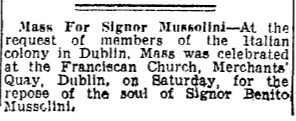
And yet the “embarrassments” continued right up until the end of the war, with both the Irish Independent and Irish Press of 7 May 1945 publishing the following short article: “Dublin Mass for Mussolini—At the request of members of the Italian colony in Dublin, Mass was celebrated at the Franciscan Church, Merchants Quay, on Saturday morning for the repose of the soul of Benito Mussolini”.
 Roman imbroglio