During the German occupation of Rome in 1943-1944, Irish religious communities in the city helped protect Jews and other people at risk of prosecution.
At dawn on 16 October, just one month after the German takeover of Rome, SS units descended on Rome’s ancient ghetto in a small area just north of the Ponte Fabricio. The German haul that day came to just over 1,000 individuals—a modest figure compared to the 13,000 Jews that the French police had caught in Paris over two days in July 1942. This was because many Roman Jews had already gone into hiding, many of them in religious institutions.
The feebleness of protests from Pope Pius XII against the round-up of 16 October has led to much criticism. Yet the pontiff did order churches and convents to offer sanctuary to all who needed it in the days before, with Irish institutions in Rome playing their part.
The Irish Christian Brothers ran a prestigious boy’s school in the centre of Rome called Marcantonio Colonna. According to the Christian Brothers’ annals, in the middle of mass in mid-October 1943 a “badly frightened Jewish gentleman”, turned up at the community’s doorstep. The man “who had a son in the school—a very talented lad too—rang our doorbell and begged to be given hospitality”, as he had just received a tip-off about the 16 October round-up. Ferdinand Clancy, rector of Marcantonio Colonna kept him in hiding for several months in one of the bedrooms on the top floor, “with the man’s wife bringing him his lunch and dinner every day”.
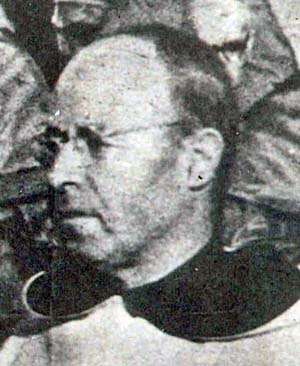
Kinsale-born John Patrick Kenneth Leahy was assistant general for the English-speaking provinces of the Carmelite Order at the Collegio San Alberto. Close by was the Scoglio di Frisio fish restaurant, which was to become famous for its star-studded clientele during the Dolce Vita years at the start of the 1960s. According to one account, Leahy hid its Jewish owner in the College, thereby earning all Carmelites the right to a discount at the restaurant after the war. Leahy also hid a number of other Jews, “giving them habits and requiring them to attend choir”.
Female orders also stepped up to the plate. One in-depth study puts at 11 the number of Jews who were hidden by the Irish-dominated Little Sisters of Mary. Also known as Blue Nuns, they helped run Rome’s most reputed hospital at San Stefano Rotondo under Mother Mary Ambrose (born Mary O’Donnell in Tipperary in 1874). The same study estimated that another Irish-dominated order, the Sisters of Charity, hid 25 Jews during the German occupation.
Much has been written about the central role that Monsignor Hugh O’Flaherty played in what became known simply as ‘the Organisation’, which by May 1944 was helping and hiding almost 4,000 individuals, including 28 people of Irish nationality. But the traces that remain of O’Flaherty’s assistance specifically to Jews are rare—even though he claimed that it was the German roundup of Jews in October 1943 that convinced him to give up his lingering anti-British sentiment and spurred him into action.
According to German church historian Hubert Jedin, who shared lodgings with the Kerryman in the Collegio Teutonico inside the Vatican, O’Flaherty “was tirelessly active in helping Jews”. On 1 October1943, the Monsignor came running into the College saying that he had spent the whole day helping Jews from falling into the hands of the police. And, on the day of the mass round-up of 16 October, Jedin recounts that “he came in a very worried state to the dining table.
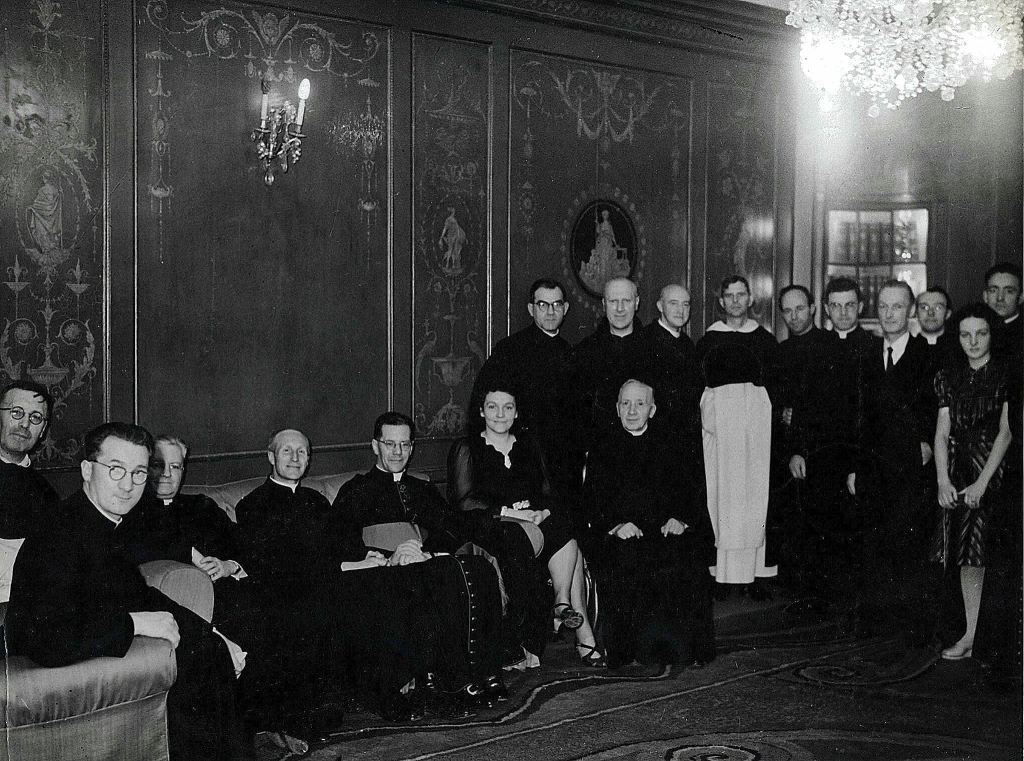
In a 1994 radio interview, the Dominican friar Leonard Boyle mentioned that an old garage still stood opposite the Basilica San Clemente in the mid-1950s. A lady there one day explained to him that O’Flaherty used to bring his car there—ostensibly for repairs, but in fact to conspire with her father about initiatives to help escaped POWs and Jews. Several accounts also mention a golden chain that a Jewish man on the run left to O’Flaherty to buy food and other supplies for his family that had sought asylum in a Roman convent. Echos of this story are to be found in the unpublished memoir left by Ines Ghiron, a Jewess, who recounts how her father-in-law “had reached an agreement with Monsignor O’Flaherty…and had found a place for me in a hostel run by the Canadian sisters in Monteverde” There, she met another Jewess called Rose-Mary Roth, who, after escape from an internment camp in northern Italy, was also helped by the Irishman after wandering destitute around Rome with her husband.
Claudio-Ilan Jacobi, then a four-year boy, remembered how he, his mother and grandparents managed to escape the 16 October round-up. Wandering around Rome, the four turned for assistance to the nuns at the Notre Dame de Namur monastery, where the mother superior, a woman of English origin known as Sister Anthony, introduced them to an “honourable monk” who turned out to be O’Flaherty. Together, O’Flaherty and Sister Anthony arranged for fake certificates for the Jewish family along with food stamps and a hiding place.
 Roman imbroglio