Member of the fascist Grand Council Edmondo Rossoni was exfiltrated from Rome to Dublin to avoid standing trial after the war.
Born in 1884, Edmondo Rossoni had a political career that was typically contorted by Italian standards. Like Mussolini, he started out as a member of the socialist party. Yet, just like Mussolini, he changed his tune once World War One broke out in July 1914. Although Italy was formally allied with Austria-Hungary and Germany, it initially remained neutral until April 1915. During this time, Rossoni campaigned for Italy’s entry on the side of the French and British, who promised it territory at Austria-Hungary’s expense. At the end of the war, Rossoni became head of the fascist-created Chamber of Labour in Ferrara in the Emilia-Romagna region, a hotbed of fascist violence before 1922.
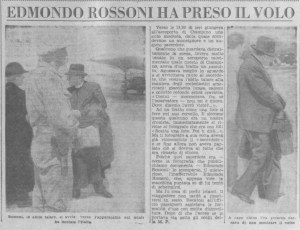
‘Edmondo Rossoni has taken flight’, Il Messaggero, 30 August 1947
And thus began Rossoni’s long ascent to the upper reaches of Mussolini’s regime. In 1930, he was appointed to the fascist Grand Council and in the mid-1930s he was minister of agriculture and forestry. Rossoni used his position amass fabulous wealth. He was suspected of having raided the coffers of the fascist trade union organisation when he was its head, and much of the gold from wedding rings gathered in a big show of patriotism at the start of Italy’s invasion of Abyssinia in 1935 may also have made its way into Rossoni’s pockets. In a letter to Mussolini, “four honest fascists” wrote that “the country knows how His Excellency Rossoni became a millionaire”. Rossoni voted against Mussolini in the motion put to the Grand Council on 24 July 1943 that toppled the fascist regime. According to the Irish minister in Rome, Michael MacWhite, Rossoni had managed to secure a Spanish visa even before the Grand Council vote so as to skip town should trouble arise.
Alas for Rossoni, he was still in Italy in September 1943 when the Germans rescued Mussolini from confinement and re-established him as the head of the Repubblica sociale italiana, a rump state in northern and central Italy. Mussolini’s new state lost no time putting a price on the head of Edmondo Rossoni, who first sought refuge inside the Vatican for a while, then in a property in Rome belonging to the Salesians.
In July 1945, Rossoni travelled to the Benedictine monastery of Montevergine in the Apennines. The war was over by this time and Mussolini safely dead. But Rossoni was still wanted by Italian justice for his role during the fascist regime. By this time, having been tipped off, Italian journalists had started to stake out the monastery. A decision was therefore taken to move Rossoni out of Italy altogether. His exfiltration from Montevergine in November 1945 was minutely prepared. Dressed as a Benedictine monk, equipped with identity papers for another member of the order called Catello Tommasini, Rossoni was collected by the monastery prior, Emanuele Caronti, and brought to another monastery in Rome, where arrangements were made to fly him to Dublin.
Caronti accompanied Rossoni/Tommasini to the airport on 30 August 1946 for his flight to Dublin via Geneva and Paris in a Vatican car carrying diplomatic corps number plates to ward off the risk of being stopped by the police. Alas, two journalists from the Roman daily Il Messaggero were waiting for them when they arrived at the air terminal. But although they alerted the police present to the false Benedictine monk, after verification of his papers he was allowed to board his flight.
After landing in Dublin, Tommasini/Rossoni immediately made his way to the Apostolic nunciature (where the Irish-American Paschal Robinson had been serving as paper Nuncio since 1929) on a purportedly special religious mission for the Benedictine order.
According to notes Michael MacWhite made in preparation for his autobiography, “the most absolute discretion prevailed” as to Rossoni’s identity and whereabouts while he lived in Dublin. During his enforced stay there, wrote MacWhite, Rossoni sometimes posed as an Italian music teacher and “gave music lessons to a number of Dublin young ladies”. According to MacWhite, he lived for a while in Ely Place in the centre of Dublin “and sometimes went under the name of Volpi”. MacWhite further mentions that Rossoni was “under the protection of Gino Paro” (the Italian monsignor who acted as Paschal Robinson’s secretary).
Rossoni’s case bears some resemblance to that of the war criminal Andrija Artuković (labelled ‘the Himmler of Yugoslavia’), who had been minister of the Interior in the puppet regime of Ante Pavelić in Croatia in 1941-1945. Artuković fled to Switzerland in 1945. Then he managed to obtain papers that allowed him and his family to find refuge in Ireland after he was recommended to the Irish legation in Berne by friends in the Franciscan order in Switzerland. Artuković lived for a year in Dublin before making it to California, before being extradited to Yugoslavia to stand trial for his wartime activities many years later.
Rossoni seems to have benefited from help higher up in the Vatican hierarchy. That such help was available was pretty common knowledge, with Ireland’s minister to the Holy See TJ Kiernan reporting to Dublin that there was “actually a section in the [Vatican’s] secretariat of state engaged in helping people who are denounced as traitors etc.”
After a time, Rossoni was amnestied, meaning he would avoid the sentence of life imprisonment previously pronounced by a court in Rome if he returned to Italy. According to MacWhite, Rossoni made his way first to Spain “as he wished to avoid any reference to the country that sheltered him for two years”. MacWhite’s recollections are not always reliable, but in his favour, he was writing less than two years after Rossoni’s flight and he mentions Nuncio Robinson as his source. An alternative version has it that Rossoni remained hidden at the apostolic nunciature in Dublin only for a few days before making his way to Canada and returning to Italy in December 1947.
 Roman imbroglio
Leave a comment