Rosminian priest Daniel Sloan faced prison (or worse) for his association with the Italian Resistance, prompting his escape against the mountains to Switzerland in 1944.
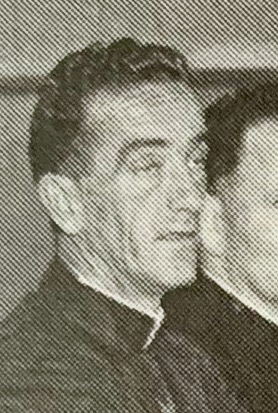
Born in 1915, Daniel Sloan was an intrepid Newry native who joined the Institute of Charity (Rosminians) and went to Rome in 1938 to study theology. Ordained in Turin in September 1941, Sloan became an administrator and teacher at the Rosminian centre at Stresa on Lago Maggiore. But when the Germans requisitioned the place in autumn 1943, he was forced to retreat to the Villa Rosminiana in Santa Maria Maggiore, a large village in the Val Vigezzo, close to the Swiss border.
In early September 1944, Sloan found himself acting as ‘chaplain’ to the partisans of the Piave division, who turned the Villa Rosminiana in Santa Maria Maggiore into a hospital as they fought to defend the new ‘Repubblica d’Ossola’ that resistance movements had formed after having expelled German and fascist forces from the mountainy area.
What Dan Sloan got up to during the brief life of the Repubblica d’Ossola is no longer known. He kept a journal of the events that, alas, was destroyed in a house fire during the 1950s. It is conceivable that he played a role in trying to convince the Anglo-Americans to supply the partisan stronghold by air and he seems to have been close to some of the partisan leaders. In a letter to a Rosminian colleage, Dario Mattioli, Sloan joked that “Moscatelli [partisan chief Cino Moscatelli] was looking for a chaplain in Val Sesia—but a chaplain that needs to be well versed in the use of dynamite”.
In the absence of Sloan’s own account, we are left with the diary kept by Mattioli, who mentions meeting Sloan returning to Santa Maria Maggiore on 12 October “dressed as a partisan with a cross of Christ on his breast” after having accompanied some wounded resistance fighters to the nearest hospital down in the valley.
But by this stage the fascists were closing in, having launched a counter-offensive that was to liquidate the Repubblica d’Ossola in a matter of days. Choices had to be made quickly. That evening, Mattioli and Sloan decided to go to the village of Malesca, about 6 kilometres from Santa Maria Maggiore, where they met anxious partisans patrolling the streets who had not eaten for four days. A biographical note written after his death mentions that at some point during these desperate days Sloan received a message smuggled from across enemy lines that warned him of the danger to his life and gave him a list of contacts in Switzerland.
On Saturday, 14 October, Sloan and his colleagues set off individually on the stiff climb up to a mountain cabin in a place called Colma di Craveggia. On the following day, they learned that the fascists had taken control of the Val Vigezzo and that the Piave division had retreated to the border crossing at Bagni. Under pouring rain, at around 4pm on 16 October, Sloan, Mattioli and another Rosminian called Don Eligio crossed a narrow wooden bridge over a stream into Switzerland along with a hundred other civilian refugees. They left behind the Rosminians’ dog, Boby, and a rear-guard of partisans determined to keep the border passage open for other refugees.
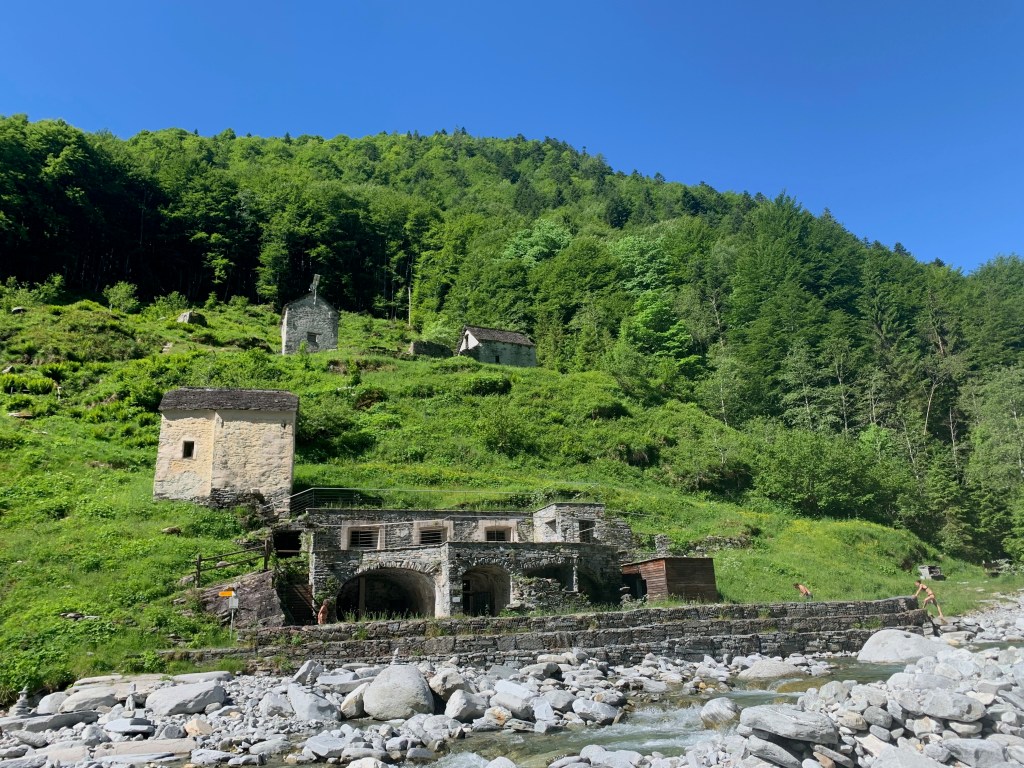
Sloan, Mattioli and Eligio along with hundreds of other Italian refugees, largely women and children, were housed by the Swiss in a makeshift shelter in the nearest village, Spruga. The following morning, 17 October, Sloan was placed at the head of a group of 69 men who were marched off to an internment camp at Locarno. After being shunted around, the three Rosminians were brought to what looked to them like a large warehouse, where Mattioli estimated that at least 500 Italian refugees had been parked. “No sooner did we enter,” wrote Mattioli, “than a huge wave of people descended on Don Sloan. It was the whole Val Vigezzo who came to salute the priest, who spent the next hour moving around spreading the good word with a smile, helping to dry tears and giving courage”.
On 18 October, just two days after they had crossed the border, Italian fascists, backed up a company of SS, reached Bagni di Craveggia. An unequal battle ensued, forcing the rear-guard group of partisans to flee across the border. Controversially, the partisan commander, Federico Marescotti, was killed by a volley of machine-gun bullets after he had reached Swiss soil. Another partisan was to die a few days later from wounds received in the same circumstances.
After Locarno, the Rosminians spent a few days in a religious institution in Bellinzona, administrative capital of the canton of Ticino. Then, on 23 October, a week after seeking asylum in Switzerland, Daniel Sloan and Don Eligio were sent to a Rosminian convent in the village of Dangio, leaving Don Mattioli in Bellinzona.
The fascists lost no time taking over the Villa Rosminiana in Santa Maria Maggiore, continuing to use it as a field hospital, just as the partisans had. “We’ll have to disinfect everything afterwards,” wrote Sloan in a letter to Don Mattioli in November.
After the war and still in Switzerland, the Rosminian Daniel Sloan wrote to the Rosminians’ Superior General, Luigi Bozzetti to explain that he would not be returning to Italy. Describing himself as “Irish-Partisan-Italian” he claimed that both the Irish provincial head and the Irish minister in Berne had forbade him from returning to Italy. Instead, he managed to obtain permission to go to England and onwards to Ireland, where he spent most of the following decade. Never of robust health, he underwent several operations for respiratory problems before he was sent to the US in 1955, living most of the rest of his life there and dying in Florida in 1999. His lengthy obituary in The Florida Catholic on 18 February 1999 makes no mention of his exploits in Italy 55 years before.
 Roman imbroglio
Leave a comment